
Magneto resistance in Bismuth
- Agriculture & Farming Lab
- Biology
- Chemistry
- Civil & Survey
- HEATING INSTRUMENTS
- Laboratory Equipments
- Laboratory Glassware
- Laboratory Plasticware
- Laboratory Plasticware
- Mathematics Kit
-
Mechanical Lab
- Actual Cut Section Working Models
- Applied Mechanics
- Different Type of Clutches of Automobile
- Different Types of Boilers
- Different Types of Boilers
- Different Types of Boilers
- Electrical Equipment Boards of Automobile
- Engine Test Rigs
- Fluid Mechanics Lab
- Heat Transfer Lab
- Hydraulics Machine Lab
- Refrigeration & Air Conditioning Lab
- Theory Of Machine Lab
- Tool Dynamometers
- Microscope
- Pankaj Test
- Pharmacy Lab Equipment's
-
Physics
- Balances
- Bi-prism and Nodal Slides
- Bridges
- Bsc Lab Experiments
- Cells , Battery & Keys
- Electronic Model
-
Experiments Of Electronics
- ADVANCE COMMUNICATION LAB
- AMPLIFIER TRAINER
- Basic Communication Lab
- Characteristics Trainer Kits
- Control Lab Trainers
- Digital Lab Trainer Kits
- E/M Trainers
- INSTRUMENTATION LAB TRAINER
- MICROCONTROLLER LAB
- Microwave Lab Trainers
- MULTIVIBRATOR TRAINERS IC-555
- Network Theorem Trainers
- Operational Amplifier Trainers
- OSCILLATOR TRAINERS
- Oscilloscopes CRO's & Function Generators
- PCB Lab Equipment's
- Physics & Material Science Lab
- Experiments Of Heat
- Experiments Of Light
- Experiments Of Matter
- Experiments Of Sound
- Galvanometers
- Heat
- Laser Experiments
- Lenses, Mirror, Prism,And Magnet
- Liquid
- Measurement Tools & Equipment’s
- Michelson Interferometer
- Models
- Msc Lab Experiments
- Multimeters
- Optics
- Physics & Material Science Lab Experiments
- Physics based Project
- Polaroide
- Potentiometer Meter Bridge Inclined
- Power Supplies
- Resistance Box ,P.O. Box,Inductance box & Capacitance Box
- SCIENCE ACTIVITY KITS
- Sound
- Telescope
- Thermometer Stop Watch
- Travelling Microscopes
- Ultrasonic Interferometer
- WEIGHT & WIRES
- Wind Mill And Engine Model
- Welding Machine
Your enquiry cart is empty!


Product Description
Magneto resistance in Bismuth
Measurement of Magnetoresistance in Bismuth
It is noticed that the resistance of the sample changes when the magnetic field is turned on. The phenomenon, called magnetoresistance, is due to the fact that the drift velocity of all the carriers is not same. With the magnetic field on; the Hall voltage V = Eyt =|v × H| compensates exactly the Lorentz force for carriers with the average velocity; slower carriers will be over compensated and faster one undercompensated, resulting in trajectories that are not along the applied field. This results in an effective decrease of the mean free path and hence an increase in resistivity.
Here the above referred symbols are defined as: v = drift velocity; E = applied electric field; t = thickness of the crystal; H = Magnetic field
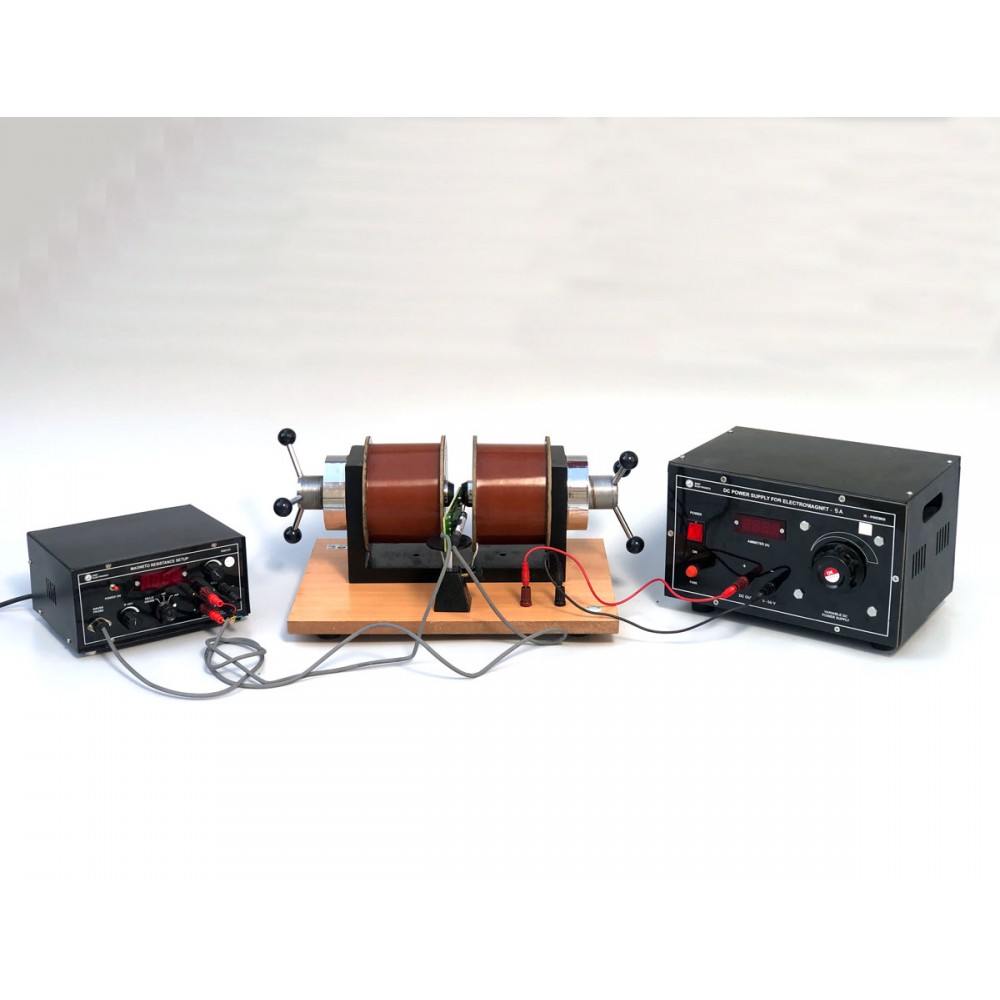
EXPERIMENTENTAL SET-UP FOR MAGNETORESISTANCE
The set-up consists of the following:
1.Hall Probe: Bismuth
2.Constant Current Source1
3.Digital Microvoltmeter
4.Electromagnet (Specifications as per datasheet attached)
5.Constant Current Power Supply (Specifications as per datasheet attached)
6.Digital Gaussmeter,(Specifications as per datasheet attached)
(1) Four Probe Arrangement
It consists of 4 collinear, equally spaced (2mm), gold plated and individually spring loaded probes mounted on a PCB strip. Two outer probes for supplying the constant current to the sample and two inner probes for measuring the voltage developed across these probes. This eliminates the error due to contact resistance which is particularly serious in semiconductors. A platform is also provided for placing the sample and mounting the Four Probes on it.
(2) Sample
Material : Bismuth
Dimensions: 10x10x1.2mm.
(3) Constant Current Source
It is an IC regulated current generator to provide a constant current to the outer probes irrespective of the changing resistance of the sample due to change in temperatures. The basic scheme is to use the feedback principal to limit the load current of the supply to preset maximum value. Variations in the current are achieved by a potentiometer included for that purpose. The supply is a highly regulated and practically ripples free d.c. source. The constant current source is suitable for the resistivity measurement of this films of metals/alloys and semiconductors like germanium.
Specifications
| Range | 0-20mA, 0-200mA |
| Resolution | 10µA |
| Accuracy | ±0.25% of reading ±1 digit |
| Display | 3½ digit, 7 segment LED with autopolarity and decimal indication |
(4) Digital Microvoltmeter
It is a very versatile multipurpose instrument for the measurement of low dc voltage. It has 5 decade ranges from 1mV to 10V with 100% over-ranging. For better accuracy and convenience, readings are directly obtained on 3½ digit DPM (Digital Panel Meter).
Specifications
| Range | 200mV, 2V & 20V with 100% over-ranging. |
| Resolution | 1mV |
| Accuracy | ±0.2% ±1 digit |
| Stability | Within ±1 digit |
| Input Impedance | >10MΩ (10MΩ on 20V range) |
| Display | 3½ digit, 7 segment LED with autopolarity and decimal indication |
The details of other sub-units can be had from their respective datasheets