
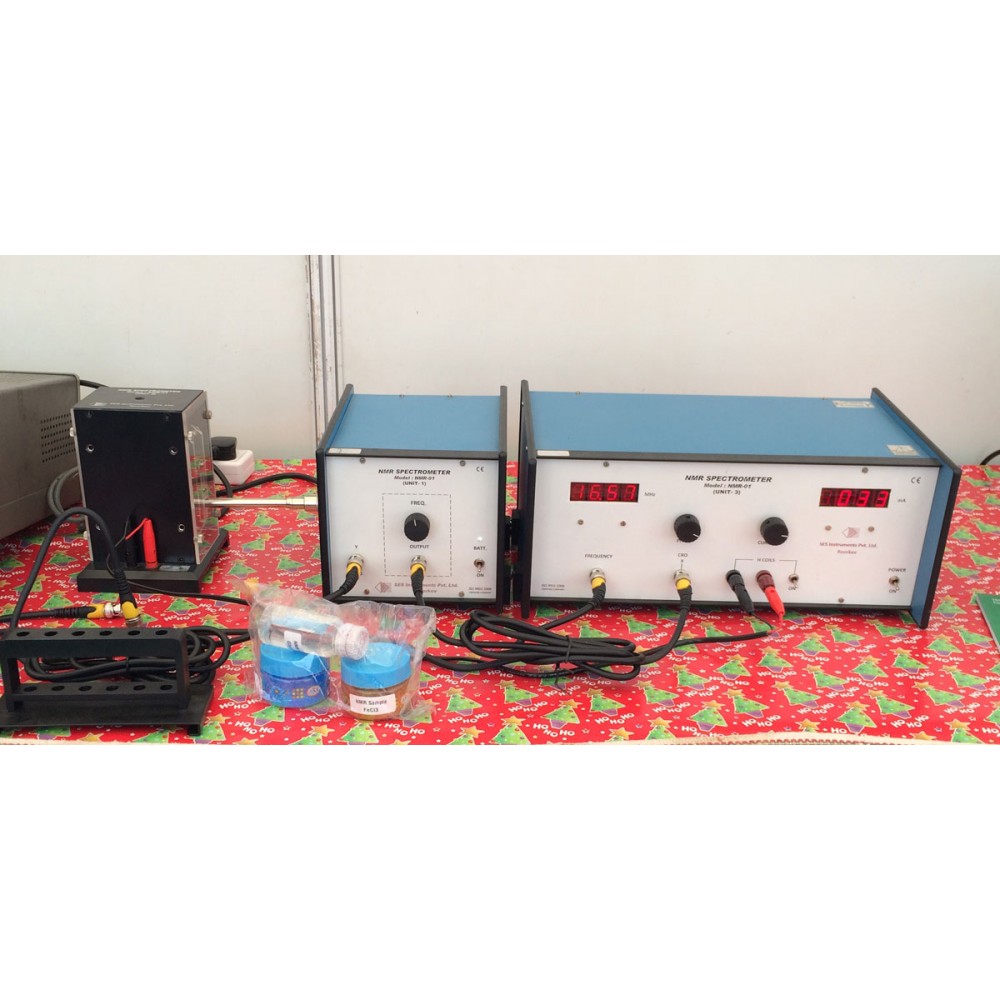

Product Description
NMR Spectrometer
Features
- Suitable for 1H and 11F nuclei
- FET based marginal Oscillator
- Digital Display of frequency and current
- Clear display of resonance peaks
- Compatible with general purpose CRO
Introduction
Nuclear Magnetic Resonance (NMR) was discovered by Bloch and Purcell in the year 1945. Over the years it has developed into a very useful and powerful tool in solid state physics, chemistry and biology. In medical application this technique, under the name Magnetic Resonance Imaging (MRI) has been developed as an excellent imaging method for clinical diagnosis. In this method use is made of Zeeman interaction of the magnetic dipoles associated with the nucleus when placed in a external magnetic field.
Elementary Magnetic Resonance
An atom whose nucleus has a nulcear spin I will have a magnetic moment µ as follows:
µ = gµnI (1)
where µn is nuclear magneton, and g is g-factor. Under the influence of an external static magnetic field (H), these nuclear magnets can orient in distinct directions. Each spin orientation corresponds to a particular energy level given by:
E = gµnHmj (2)
with mj = -I, -(I-1), ...............(I-1), I
where mj is magnetic quantum number
The splitting of levels will therefore be:-
DE = gµnH or = hn0 (3)
where n0 is the r.f. frequency applied perpendicular to the static magnetic field. Now if the spins are subjected to a purturbation by an oscillating magnetic field with its direction parallel to the static magnetic field and its frequency n1 such that the quantum hn1 is equal to DE = hn0 , we say that there is a resonance between n1 and n0. This will induce transition between neighbouring sub levels (mj=I) and in turn will absorb energy from the oscillating field. Thus, at resonance, we get a peak due to the absorption of energy by the system.
Experimental Technique
In our experiment the NMR signals of Hydrogen nuclei and Fluorine nuclei are detected. Both have only two possible orientations in reference to static magnetic field H since both have proton spin I = 1/2. The sample is placed in an r.f.coil located between the gap of homogeneous magnetic field H. In order to exactly match equation (3), H is modulated at constant frequency (50Hz in our case) by using two modulation coils. Each time when the matching (resonance) condition (Eq. 3) is fulfilled, energy is absorbed from the r.f.coil due to the spin transition.
Description of the NMR Spectrometer
A block diagram of the NMR Spectrometer is given below in Fig. 1, and a brief description follows.
Basic Circuit
The first stage of the NMR circuit consists of a critically adjusted (marginal) radio frequency oscillator with 4-digit frequency display. This type of oscillator is required here, so that the slightest increase in its load decreases the amplitude of oscillation to an appreciable extent. The sample is kept inside the tank coil of the oscillator, which in turn, is placed in the 50Hz magnetic field, generated by the Helmholtz coils and a permanent magnet. At resonance, i.e. when the frequency of oscillation equal to the Larmour’s frequency of the sample, the oscillator amplitude registers a dip due to the absorption of power by the sample. This obviously, occurs periodically two times in each complete cycle of the modulating magnetic field. The result is an amplitude modulated carrier which is then detected using a FET demodulator and amplified by an op-amp circuit.
Permanent Magnet
Two high field permanent magnets have been used in H structure and adjusted to produce highly uniform high magnetic field.
50Hz Sweep Unit
A 50Hz current flows through Helmholtz coils which provides a low frequency magnetic field to the sample.
Oscilloscope (not supplied with the Spectrometer)
Any dual trace oscilloscope normally available in the laboratory would be quite suitable.
Advantages and Limitations of our Spectrometer
- The instrument is basically designed for postgraduate laboratories keeping in view their requirements and limitations.
- The observation of NMR at low perturbing magnetic fields with high ~5KG static field and consequently in radio-frequency region makes its instrumentation and working a lot simple and within the reach of postgraduate students. Good resonance peaks can be obtained as a class room exercise.
- The spectrometer is complete in all respects except a CRO.